
I recently took part in a month’s free trial of “Unlimited Video Learning with the World’s Greatest Professors” via The Great Courses Plus. Sadly, I only had time to complete three courses. I wish I could have done three times that!
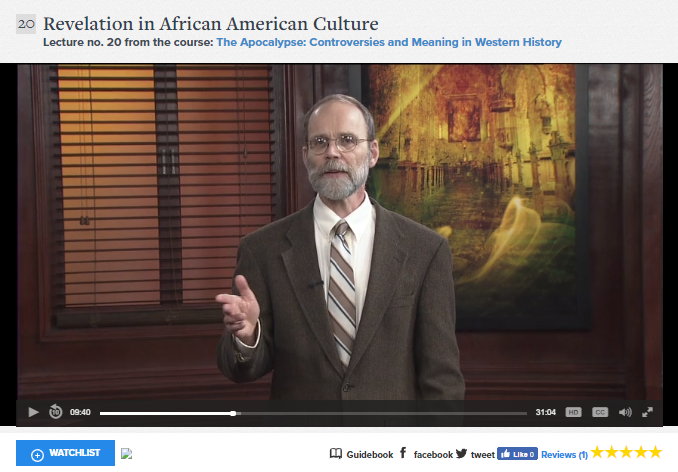
The first course I took during my trial month of The Great Courses Plus was The Apocalypse: Controversies and Meaning in Western History taught by Professor Craig R. Koester. Koester has an easy, smooth style that makes listening to him a pleasure. I could listen to that voice all day!
This course consists of 24 Lectures, each roughly thirty minutes in length:
1. Revelation and the Apocalyptic Tradition
2. Apocalyptic Worldview in Judaism
3. Apocalyptic Dimension of Early Christianity
4. Origins of the Book of Revelation
5. Issues Facing Revelation’s First Readers
6. God, the Lamb, and the Seven Seals
7. Seven Trumpets, Temple and Celebration
8. The Dragon and the Problem of Evil
9. The Beasts and Evil in the Political Sphere
10. The Harlot and the Imperial Economy
11. The Battle, the Kingdom, and Last Judgement
12. New Creation and New Jerusalem
13. Antichrist and the Millennium
14. Revelation’s Place in the Christian Bible
15. The Apocalypse and Spiritual Life
16. The Key to the Meaning of History
17. Apocalyptic Fervor in the Late Middle Ages
18. Luther, Raedicals, and Roman Catholics
19. Revelation Takes Musical Form
20. Revelation in African American Culture
21. The Apocalypse and Social Progress
22. Awaiting the End in 1844 and Beyond
23. Rapture, Tribulation, and Armageddon
24. The Modern Apocalyptic Renaissance

1. The Nature and Origins of Evil
2. Enuma Elish — Evil as Cosmic Battle
3. Greece — Tragedy and The Peloponnesian War
4. Greek Philosophy — Human Evil and Malice
5. The Hebrew Bible — Human Rivalry with God
6. The Hebrew Bible — Wisdom and the Fear of God
7. Christian Scripture — Acopcalypse and Original Sin
8. The Inevitability of Evil –Irenaeus
9. Creation, Evil, and the Fall — Augustine
10. Rabbinic Judaism — The Evil Impulse
11. Islam — Iblis the Failed, Once-Glorius Being
12. On Self-Deception in Evil — Scholasticism
13. Dante — Hell and the Abandonment of Hope
14. The Reformation — The Power of Evil Within
15. Dark Politics — Machiavelli on How to Be Bad
16. Hobbes — Evil as a Social Construct
17. Montaigne and Pascal — Evil and the Self
18. Milton — Epic Evil
19. The Enlightenment and Its Discontents
20. Kant — Evil at the Root of Human Agency
21. Hegel — The Slaughter Block of History
22. Marx — Materialism and Evil
23. The American North and South — Holy War
24. Nietzsche — Considering the Language of Evil
25. Dostoevsky — The Demonic in Modernity
26. Conrad — Incomprehensible Terror
27. Freud — The Death Drive and the Inexplicable
28. Camus — The Challenge to Take Evil Seriously
29. Post-WWII Protestant Theology on Evil
30. Post-WWII Roman Catholic Theology on Evil
31. Post-WWII Jewish Thought on Evil
32. Arendt — The Banality of Evil
33. Life in Truth — 20th Century Poets on Evil
34. Science and the Epircal Study of Evil
35. The “Unnaming” of Evil
36. Where Can Hope Be Found?

My favourite of the courses I took, though, was Heroes and Legends: The Most Influential Characters of Literature, which was taught by Professor Thomas A. Shippey, Ph.D. The thirty minute (ish) lectures include twenty-four captivating characters:
1. Frodo Baggins — A Reluctant Hero
2. Odysseus — The Trickster Hero
3. Aeneas — The Straight Arrow
4. Guinevere — A Heroine with Many Faces
5. The Wife of Bath — An Independent Woman
6. Cressida — A Love Betrayed
7. Beowulf — A Hero with Hidden Depths
8. Thor — A Very Human God
9. Robin Hood — The Outlaw Hero
10. Don Quixote — The First of the Wannabes
11. Robinson Crusoe — A Lone Survivor
12. Elizabeth Bennet — A Proper Pride
13. Natty Bumppo and Woodrow Call — Frontier Heroes
14. Uncle Tom — The Hero as Martyr
15. Huckleberry Finn — Free Spirit of America
16. Sherlock Holmes — The First Great Detective
17. Dracula — The Allure of the Monster
18. Mowgli — The Wolf Child
19. Celie — A Woman Who Wins Through
20. Winston Smith — The Hero We Never Want to Be
21. James Bond — A Dangerous Protector
22. Fairy-Tale Heroines — New-Style Princesses
23. Lisbeth Salander — Avenging Female Fury
24. Harry Potter — Whistle-Blower Hero

I chose courses relevant to my interests but there are no shortages of topics to pick from. The Great Courses Plus offers everything from Dog Training 101 to Mysteries of the Microscopic World. It’s a cliche, but there’s something for everyone here.
The Great Courses Plus website is user friendly. It’s well-organized and clean, which makes it easy on the eyes. “My Watchlist” keeps track of your courses, allowing you to reorder them as necessary. Each course remembers where you left off and automatically starts the next lecture, proceeding seamlessly. You can also sync the site to your other devices, making it easy to carry on with your courses on the go.
 There are a few things I thought would have improved the site, mind. While the lectures were interesting, I would have liked to have followed them up with a quick quiz to check understanding. It would have been good to have a forum as well, to discuss the courses with other users. The lack of these options doesn’t detract, though. They would just improve the overall experience.
So… do I think it’s worth it? Absolutely. The Great Courses Plus is ideal for lifelong learners. As soon as I can figure out how to fit the monthly subscription fee into my budget, I’m coming back! Try out The Great Courses Plus for yourself and let me know how you go on.