You might think that I first discovered Baba Yaga
through my lifelong study of witchcraft and the occult. You would, of course,
be wrong.
Because I wasn’t just a baby witch in school.
I was also (and remain) an incurable geek.

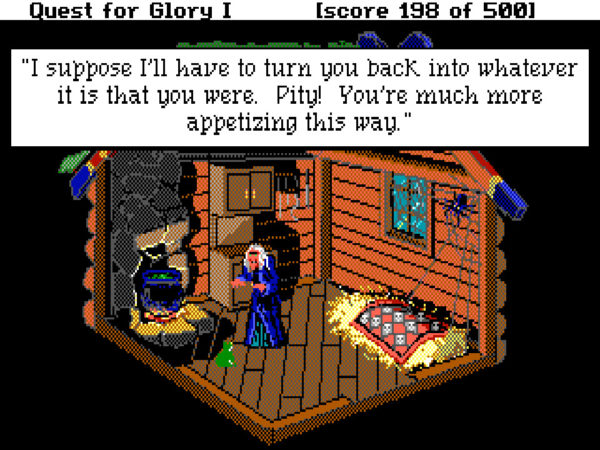
One of my favorite DOS-based games growing up was Sierra’s
Quest For Glory (aka: So You Want To Be A Hero.) In it, you can play
as a Fighter, a Magic User, or a Thief on your quest to become a hero. (No
points for guessing which I always chose!)
One of the would-be hero’s quests takes him to the
foot (feet) of Baba Yaga’s house where he, hopefully, has learned to say “hut
of brown now sit down” to gain access and meet the old witch. And… for many
years, that was it. That quest was all I knew (or, honestly, cared) about Baba
Yaga.
My interest grew as I aged and, like many women at my stage of life, felt a pull to her dark mythos. Toward her brutal justice. Her often-cruel
kindness. The more I’ve experienced of the world, of life, the more intrigued
I’ve become by the mercurial old witch.
No longer a whimsical character from a game, I can see
Baba Yaga for what she is: The fearsome embodiment of feminine knowledge. The too-often
hidden truth of women’s power over life.
And death.
I’m hardly alone in my fascination.
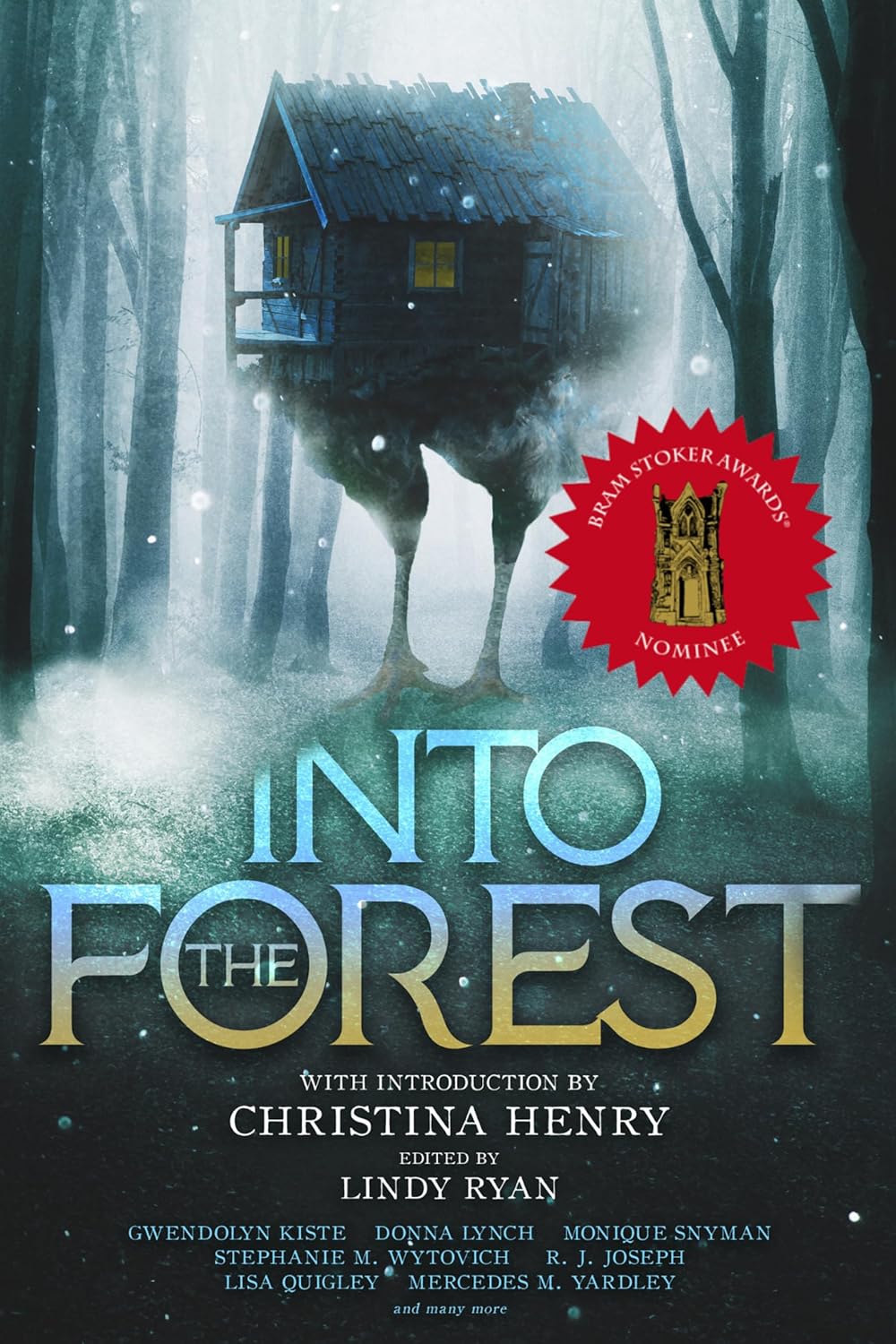
In 2022, editor Lindy Ryan brought together some of
the best women in horror (sadly, not me hah) to pay tribute in an anthology
titled Into the Forest: Tales of the Baba Yaga. Many of the names
included are familiar, some are friends, and still others are some of my favourites.
Each author included brings her unique vision, her experience, her deepest
fears – and darkest desires – together to create an engaging anthology
dedicated to the fearsome witch of Slavic lore.
As I always say with anthologies, not every story is
going to resonate with every reader – but the best ones have something for
everyone. Personally, for example, I prefer anthologies that don’t mix poetry
and fiction (as this one does.) For me, it’s kind of like finding a Skittle in
a bowl of M&Ms: each yummy on their own, but no fun to chomp on together.
I wanted to go ahead and get one of my biggest
problems with Into the Forest out of the way so I could focus on some of
the excellent contributions. Of which there are many.
The nature of anthologies makes it hard to balance vision
and quality. While the stories in Into the Forest feel clumped together
awkwardly in terms of time and place, they certainly don’t suffer from any lack
of vision or quality! It’s rare to find so many stories in a collection from
different authors that earn solid 5/5 ratings, but Into the Forest ladles
them up liberally from its cauldron.
Let’s talk about them:
“Dinner Plans with Baba Yaga” by
Stephanie M Wytovich (3/5) is evocative (but is also victim of my prejudice
against poems in fiction anthologies.)
“Last Tour Into the Hungering Moonlight” by
Gwendolyn Kiste (5/5) is wonderfully irreverent. Droll. It expresses that
yearning for the thing you can’t quite name and is heavy with silent feminine
despair.
“The Story of a House” by Yi
Izzy Yu (5/5) is exactly that: the story of Baba’s chicken-footed house
that is both crueler and more heartbreaking than you expect.
“Of Moonlight and Moss” by Sara
Tantlinger (3/5) brings us queer high fantasy about reclaiming female power
that probably gets too low a rating because I’ve not been connecting with the
genre lately.
“Wormwood” by
Lindz McLeod (5/5) is a brief glimpse of Baba Yaga’s benevolence, with an
emphasis on mirrors that act as reminders that people are simply mirrors of the
societies in which they live.
“Mama Yaga” by
Christina Sing (5/5) is an unexpectedly humorous Hansel & Gretel
crossover.
“Flood Zone” by Donna
Lynch (2/5) is deep but dreary. It feels like it connects less with the
theme than others.
“The Peddler’s Promise” by Catherine
McCarthy (4/5) is harder read because it unapologetically refuses to be
more accessible – but is enjoyable for the same reason.
“The Space Between the Trees” by
Jo Kaplan (5/5) is an unsettling look at the relationship between mother
and daughter that’s frighteningly universal.
“Sugar and Spice and the Old Witch’s Price”
by Lisa Quigley (5/5) is more modern, more relatable, than many others.
It addresses the hopeless rut of motherhood and is one of my absolute favorites
because of how perfectly nasty it is.
“Birds of a Feather” by Monique
Snyman (3/5) reminds us that the real appeal of Baba Yaga is that her
stories are all about choices. Even though I didn’t really connect with the
character, I’d love to read more stories about Baba Yaga as an immigrant in
today’s society.
“Water Like Glass” by Carina
Bissett (3/5) is a sapphic tale of life & death & Rebirth that, unfortunately,
feels quite heavy.
“Herald the Knight” by Mercedes
M. Yardley (4/5) becomes a little muddled at the end but is so captivating
that I’d love to read more.
“All Bitterness Burned Away”
by Jill Baguchinsky (5/5) is another Hansel and Gretel crossover. Short
and sweet(ish.)
“A Trail of Feathers, A Trail of Blood”
by Stephanie M. Wytovich (5/5) leaves you feeling a little confused
about what actually happens at the end but uses such powerful imagery that you really
feel the urgency and despair that drive the story there.
“Baba Yaga Learns to Shave, Gets Her Period, Then
Grows into Her Own” by Jess Hagemann (2/5) struck me as a
half-formed idea. It’s too… distant for me to really get – but it has been
an awfully long time since I was a teenager!
“Fair Trade” by Jacqueline
West (5/5) brings a smile to your face with a surprisingly satisfying
ending.
“Stork Bites” by Ev
Knight (2/5) is short and, frankly, a bit forced. Although it has
entertaining moments, it’s too disjointed to really get into.
“Chicken Foot” by Octavia
Cade (3/5) is somber. It reeks of defeat and disappointment and feels…
incomplete.
“Where the Horizon Meets the Sky”
by R.J. Joseph (1/5) is the only story I actually dislike. It’s mundane
and obvious, with awkward dialogue and a Baba that’s so poorly developed she’s
unrecognizable.
“Maw Maw Yaga and the Hunter”
by Alexandrea Weis (2/5) is a clever tale of nature’s revenge that would
work better if the setting were better developed.
“Baba Yaga in Repose” by Heather
Miller (4/5) is somber. It’s sad – but not hopeless. This is the story the
anthology should have ended on.
“Shadow and Branch, Ghost Fruit Among the Lullabies”
by Saba Sayed Razvi (4/5) isn’t a story so much as an invocation that
ends too soon.
Into the Forest will,
naturally, appeal more to women. It is, after all, a women-in-horror anthology,
written by women, about women, for women. That being said, I feel like there
are a whole lot of men out there who could benefit from reading this book.
Or, failing that, a chance encounter with an old woman
in the woods…
Rating: ⭐⭐⭐⭐ (4/5 stars)